How private is your GenAI conversation?
Turning off model training is a useful step. Understand what it changes—and what it leaves unanswered.
A manager wants an AI assistant to challenge a draft business plan. Before uploading it, they turn off the option that allows their conversations to improve the provider’s models. Then they add the document, including its customer names, pricing assumptions and acquisition plans.
This illustrative scenario exposes an important gap: a useful privacy setting can be mistaken for permission to share confidential information.
The setting matters. But deciding whether the document belongs in that service requires a wider judgment.
Start with the control you can change
Consumer AI services provide choices about model training. If you do not want your conversations used for that purpose, check the settings available to your account:
- ChatGPT: go to Settings → Data controls → Improve the model for everyone and switch it off. OpenAI says new conversations will not be used for training; they can still remain in your history. OpenAI’s instructions.
- Claude: go to Settings → Privacy → Help Improve our AI models and switch it off. Anthropic says new chats and coding sessions will not be used for future model training. The change does not undo training already underway or completed. Anthropic’s instructions.
These controls have boundaries. OpenAI says a conversation submitted through feedback may be used for training even after an opt-out. Anthropic describes separate feedback uses and safety-related exceptions. Read those alongside the toggle—not as an afterthought. OpenAI feedback policy, Anthropic’s policy.
Ask what the setting leaves unanswered
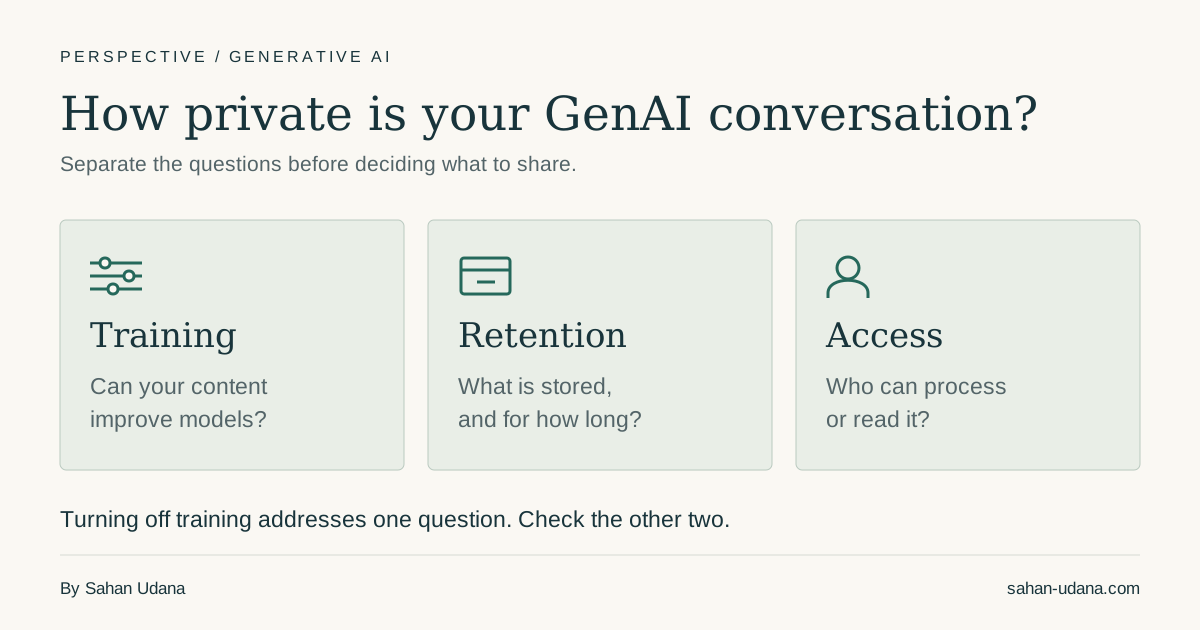
Three questions help make the decision more precise:
Training: can the content be used to improve models?
Retention: what content is stored, where, and for how long?
Access: which organisations, administrators or connected services can process or read it?
A training opt-out addresses the first question. It does not establish the answers to the other two. OpenAI’s API documentation, for example, distinguishes training use from abuse-monitoring records and endpoint-specific storage. OpenAI API data controls.
For a leadership team, the consequence is practical: approval should identify the service, account type and permitted information. A general instruction to “use AI responsibly” leaves too much for each employee to interpret.
Choose the arrangement, not just the model
Consumer applications, business workspaces and API access can have different terms. OpenAI’s business offerings and API, and Anthropic’s commercial services, do not use inputs and outputs for training by default, subject to choices such as voluntary sharing or feedback. Those protections should be evaluated alongside retention and access arrangements. OpenAI business data policy, Anthropic commercial policy.
Self-hosting adds another choice. An application such as LibreChat can provide one interface for several model providers. Hosting that workspace yourself gives you control over its configuration and stored information. When it calls an external model API, however, the request still goes to that provider. LibreChat provider documentation.
Bringing your own API key identifies how access is authorised. It does not establish that a hosted platform cannot see or store the request. The relevant question remains: which parties handle the information, under which controls?
Make the information decision explicit
Return to the business-plan example. If the task is to challenge the logic, a fictional scenario or a carefully reduced extract may be enough. If the actual confidential document is essential, use an environment approved for that information and task. Removing names alone may leave commercially sensitive details intact.
Leaders should make three decisions clear: what information may be submitted, which services and account types are approved, and who owns exceptions and periodic review.
A privacy setting is valuable when people understand what it changes. An operating policy is valuable when they know what they are still responsible for deciding.